Assignments
Codecademy – Week 1 (01/23/2017)
The tutorials on Codecademy were very effective in teaching me the basics of HTML and CSS. I now have sufficient knowledge to view the source code of simple webpages and recognize which parts of the code are responsible for the content I see in my browser. I also now have adequate knowledge to code a basic webpage starting from scratch and edit existing code (e.g., modifying templates) with the content that I want and styled the way I want.
The most important lesson I learned–and what may prove to be the most useful guideline in designing my portfolios for this class–is that HTML should generally be used for creating the structure and content of a webpage, whereas CSS should be used to apply style to and manage the presentation of that content. By keeping content and presentation separate, I can more easily maintain a cohesive look for all of my pages.
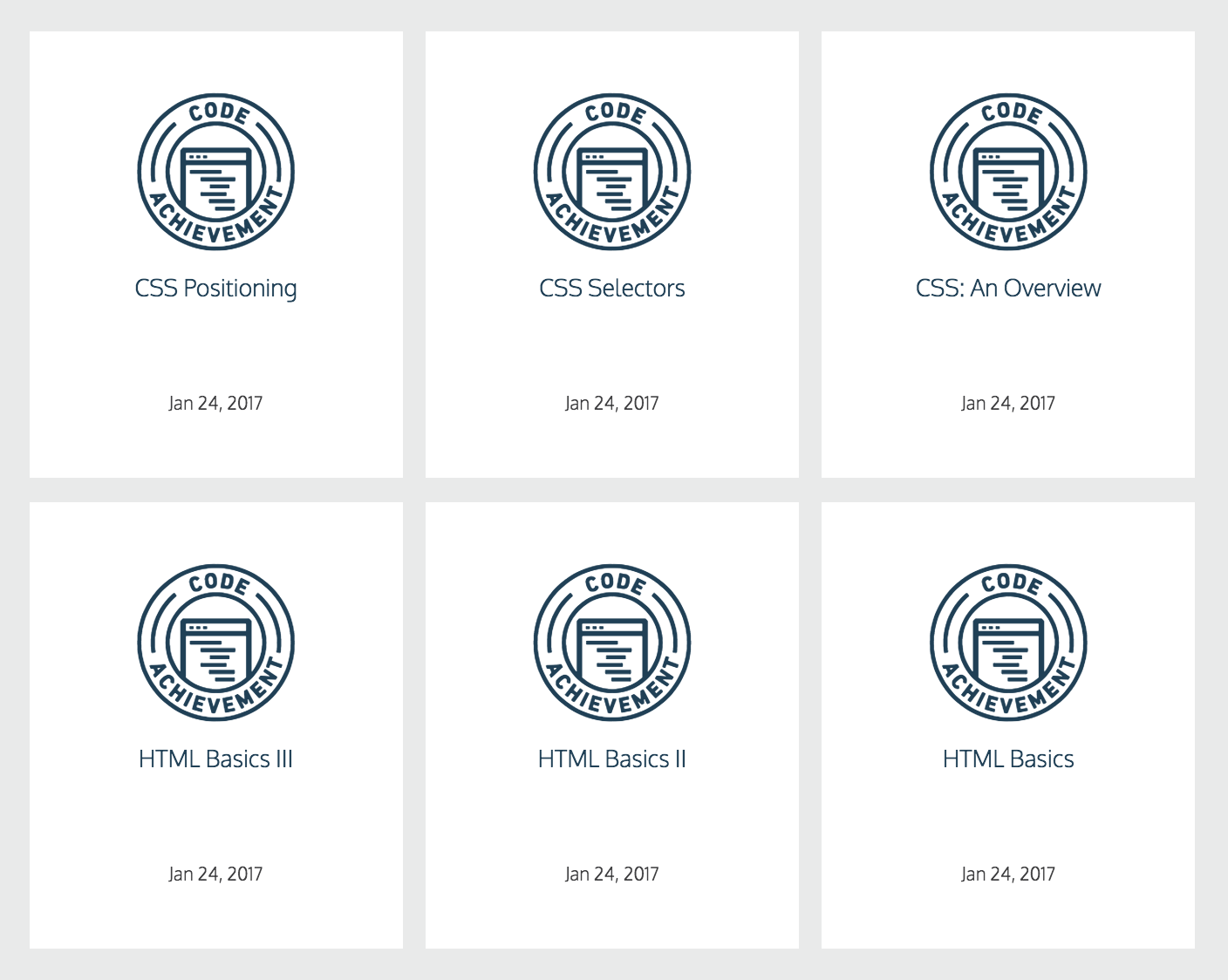
Below are the Codecademy achievement badges I earned for completing the six tutorials (click thumbnail to view full size image).
W3Schools – Week 2 (01/30/2017)
In addition to serving as a helpful review for the concepts I had already learned in Codecademy, the HTML, CSS, and Bootstrap tutorials on W3Schools taught me many new things that HTML and CSS can do. Because W3Schools covers far more material than the basics from the Codecademy tutorials, it is an excellent resource for HTML and CSS. In fact, in creating my assignment portfolio, I have already consulted W3Schools many times.
The W3Schools HTML tutorial initially covers fundamental concepts, such as what HTML is and how to create and edit HTML documents. Then, it teaches the basic structure of HTML documents (e.g., html document type declaration, head, and body) and how to incorporate basic elements (e.g., headings, paragraphs, tables, lists, images, links, etc.), as well as how to modify the attributes of those elements (e.g., id, class, inline style, etc.). Furthermore, it goes over more specialized elements, like quotation and computer code elements.
Similarly, the W3Schools CSS tutorial begins by going over fundamental concepts, like what CSS is and how to create and edit CSS documents. It then explains CSS syntax and how CSS relates to HTML elements. From there, the tutorial covers many different ways that CSS can style various elements, including but not limited to borders, margins, fonts, icons, lists, tables, text, and images.
The Bootstrap tutorial shows the full capabilities of HTML and CSS (and JavaScript) in developing responsive, mobile-first pages. The free framework provides users with numerous templates for tables, images, buttons, navbars, panels, forms, and many other things that have been designed to effectively adapt to device screens of all sizes.
Although I am unable to commit every single aspect of HTML and CSS to memory, I now know the basics of HTML and CSS, as well as know of their more advanced features, so I can consult resources like W3Schools when necessary. This knowledge will be crucial in developing portfolios that effectively showcase my deliverables and communicate my class experiences.
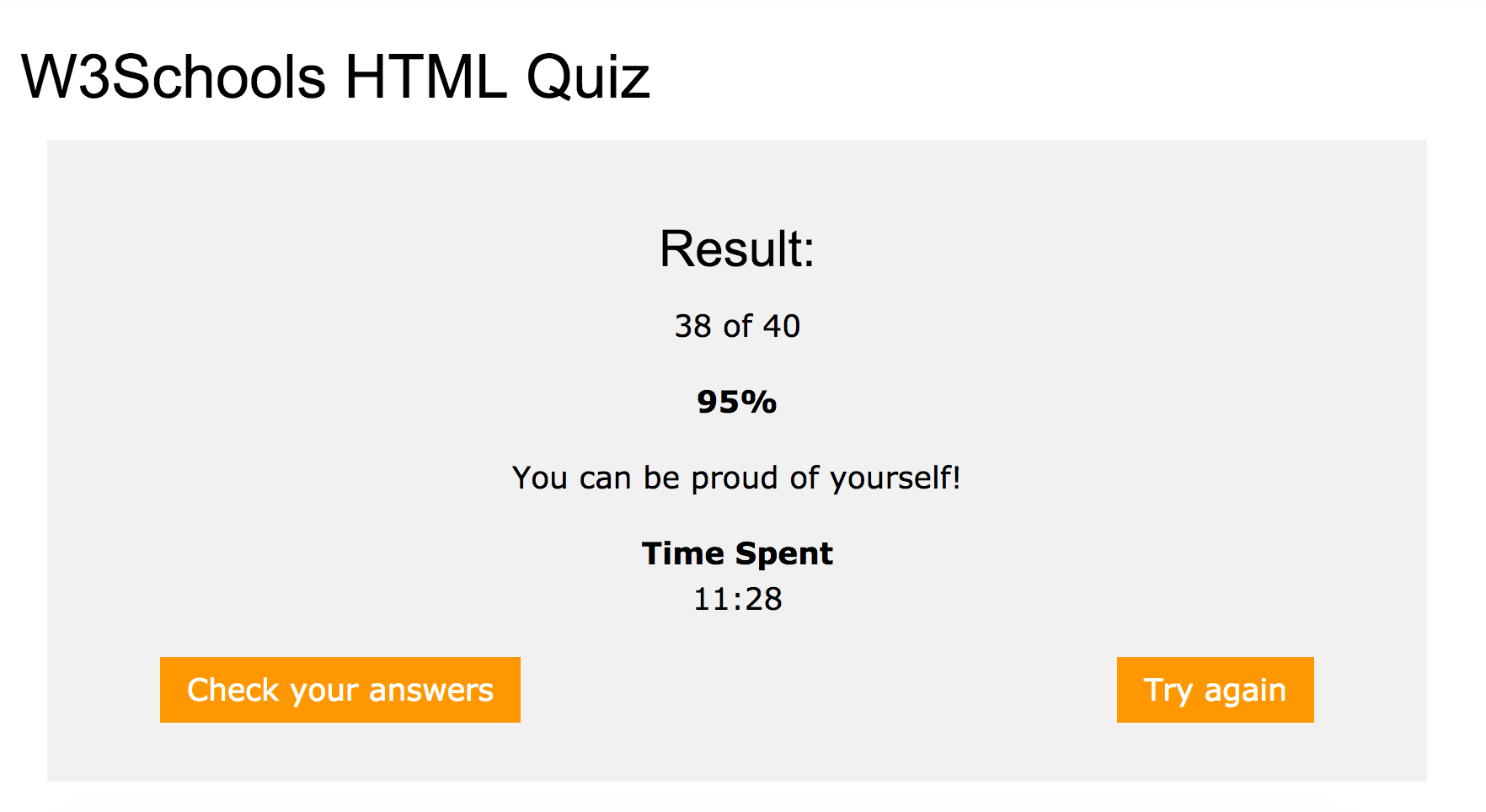
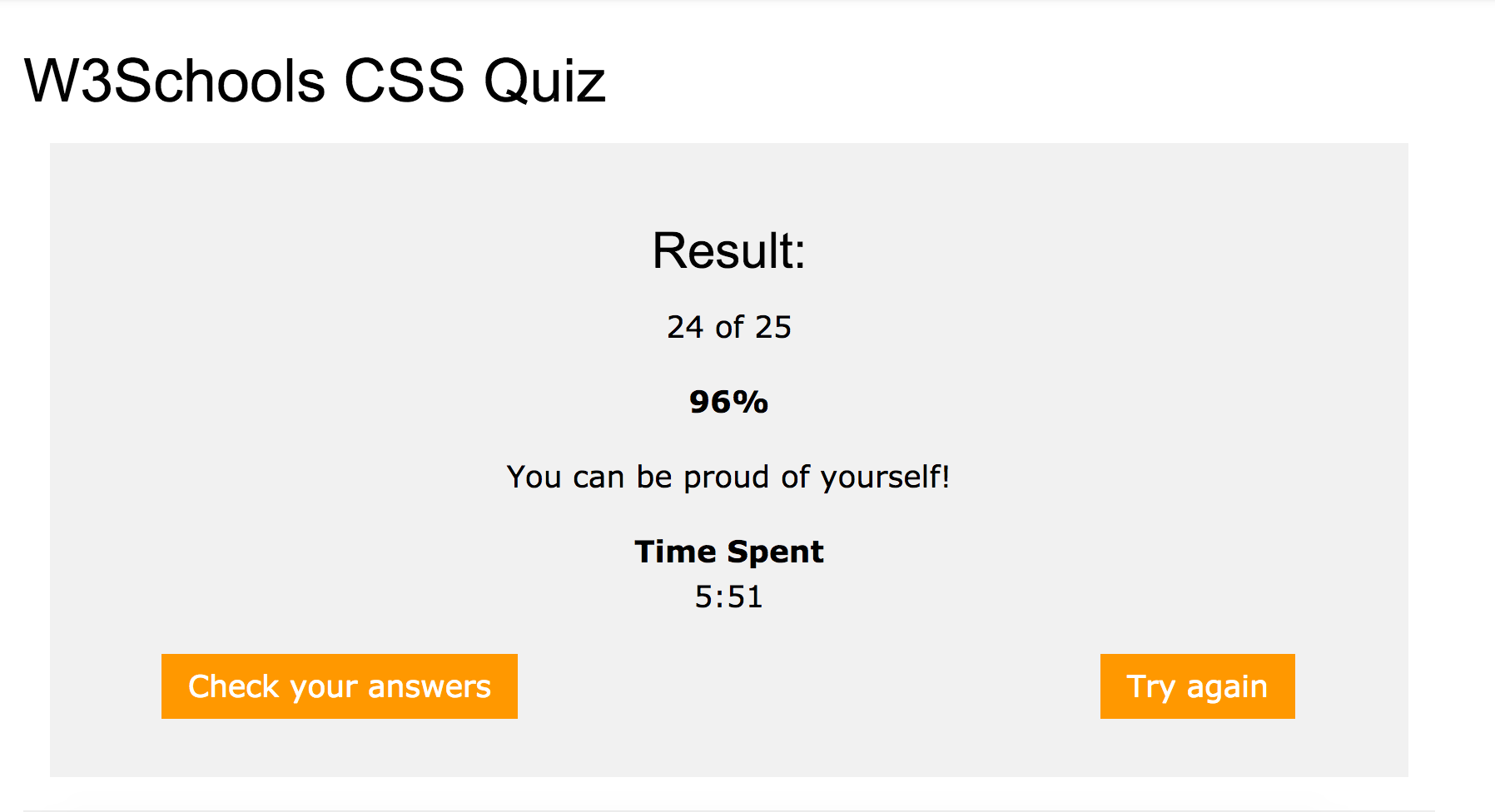
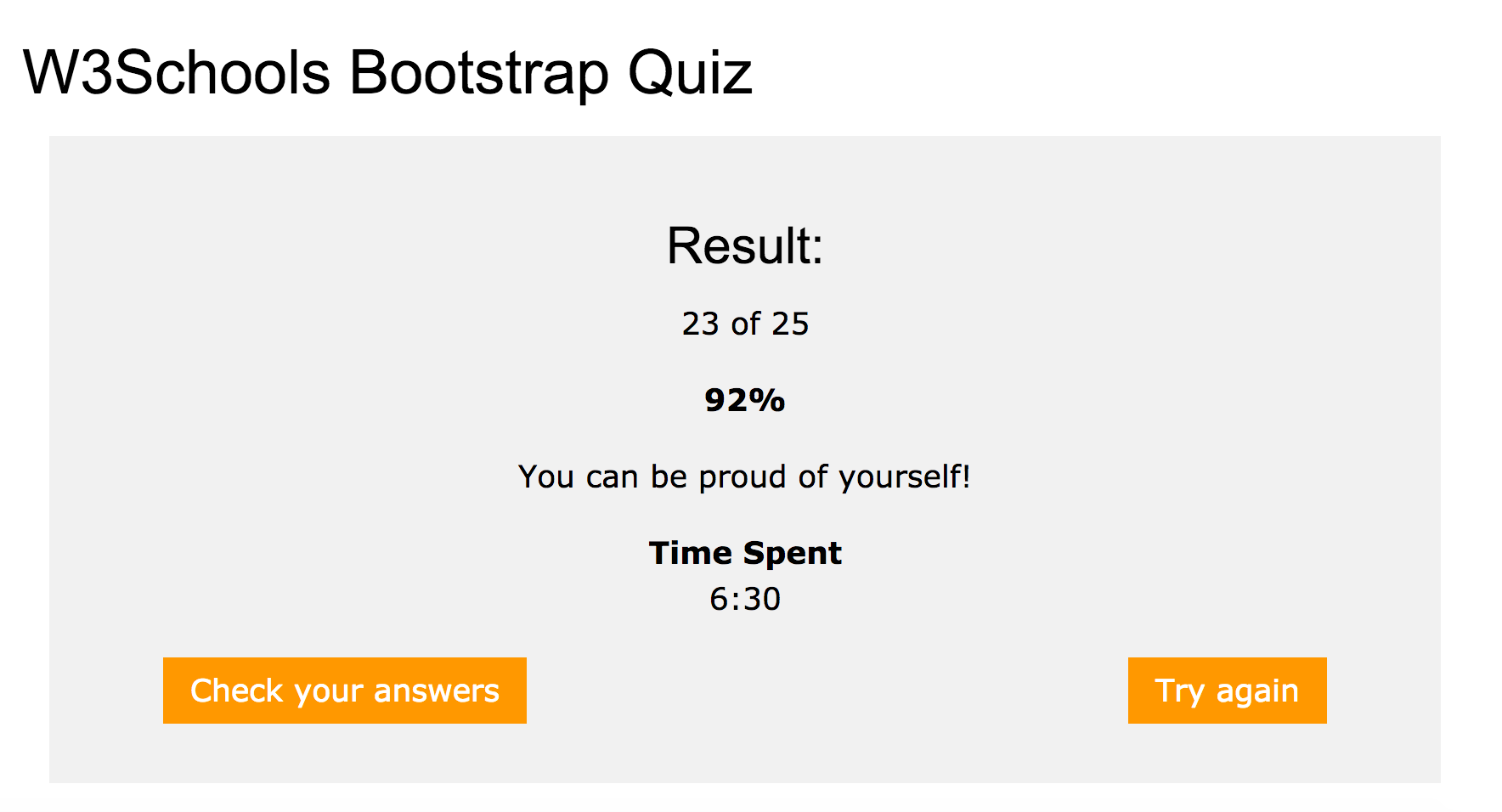
Below are the results from the W3Schools quizzes, which demonstrate that I possess basic knowledge of HTML and CSS (click thumbnails to view full size images).
The Starfish and the Spider – Week 3 (02/06/2017)
The introduction and first chapter of The Starfish and the Spider by Brafman & Beckstrom introduces the concept of decentralization. Brafman & Beckstrom analogize the operations of 2000s file-sharing applications, like Napster and Kazaa, to the Apaches of centuries past. Although unorthodox, the comparison is apt, and the analysis may even be more broadly applied to the Internet, the success of which has relied on being open and collaborative. In short, decentralized products thrive under decentralized organizations, and centralized products thrive under centralized organizations.
My answers to the discussion questions, which cover the aforementioned topics as well as others, may be viewed below.
Discussion Questions
1. In the seventeenth century, why were the Spaniards unable to defeat the Apaches? What implications does this have concerning current or future organizational competition?
The Apaches were unable to defeat the Spanish because their power was decentralized (19). Unlike with the Aztecs and Incas, the Apaches had "no clear leader, no hierarchy, and no headquarters" (19). Consequently, Apache attacks were difficult to predict, as they could be conceived, organized, and executed in completely different places and by different people (20).
Furthermore, because the Apaches' power was decentralized, the Spanish's strategy of simply killing a group's leader to render them helpless was largely ineffective (21). When one "leader"--that is, one who leads by example and not by mandate--is killed, another took his place, and society continued without missing a beat (21). Likewise, when the Spanish destroyed the Apaches' villages, the Apaches simply became nomads (21).
Although complete adoption is impractical for companies because clear leaders and headquarters are vital for business operations, current and future organizations may wish to consider adopting certain aspects of decentralization. For example, resources and supply can be effectively decentralized, as is the case with a company like Uber, which relies on independent contractors for their drivers.
2. Briefly compare and contrast centralized and decentralized organizations.
Decentralized organizations have "no clear leader, no hierarchy, and no headquarters" (19). Members of these open systems are free to make their own decisions and share power with all others (19, 21). Leaders arise by leading through example, not through mandates (19). Centralized organizations, on the other hand, are coercive systems that have distinct leaders who operate by command-and-control and specific places where decisions are made (19). The leaders set and enforce the rules, and others are expected to follow them (19).
3. List a few of the traits of a decentralized organization.
Decentralized organizations are based on "flexibility, shared power, and ambiguity" (21). They have "no clear leader, no hierarchy, and no headquarters," which allows them to more effectively adapt to situations where any one member is removed (19). Members of these open systems are free to make their own decisions and share power with all others (19, 21). Leaders arise by leading through example, not through mandates (19).
4. From a technical perspective, what is the primary difference between Napster and Kazaa?
The primary difference between Napster and Kazaa is that whereas Napster required a central server to operate, Kazaa did not (22). Kazaa allowed users to directly link with other users (22).
5. Is this reading relevant to the current competition between new organizations such as Uber and Lyft and existing taxi companies? Why or why not?
The reading is somewhat relevant to today's ongoing battle between taxis and services like Uber and Lyft. Neither Uber nor Lyft are truly decentralized organizations. Both have clear leaders and headquarters; that is, if funding were to dry up and all of upper management were removed, their services would quickly cease. The decentralized aspect of their companies is the nature of their services, which relies upon a pool of drivers, who are all independent contractors.
The most applicable part of the reading may be the pushback by established forces against innovation and the consequences that arise from it. Where Napster failed, Kazaa picked up. By changing its approach, Kazaa was able to achieve greater sharing success. When the law finally caught up to Kazaa, applications like Kazaa Lite popped up, and when that faced troubles, other applications like eMule took its place (24-25). Each iteration of a file sharing application built upon what was learned from the failures of their predecessors and, as a result, was able to more closely achieve its goal of free sharing without fear of legal reprisal.
Similarly, we may see analogous developments between services like Uber and Lyft and the taxi companies they face. Taxi companies have railed against Uber and Lyft with some success, as their services have been halted or restricted in many cities across the world. However, these successes will ultimately be short-lived, as ridesharing services--whether it be Uber, Lyft, or somebody else entirely--will continue to find ways to beat the existing system.
CSS: Selectors in Action (Liquid Layout) – Week 3 (02/06/2017)
The tutorial on Max Design used a step-by-step approach to show me how to transform a page with plain text into a page with a more sophisticated three-column liquid layout. It showed how to (1) organize content into modular div container elements and (2) manipulate the style and appearance of those elements by using CSS. Although internal styling was used in the tutorial, the code can be easily adapted to instead use an external stylesheet by transferring the relevant style code to an external stylesheet and properly referencing the stylesheet in the HTML file.
The finished sample page may be previewed below. To view the page in a separate tab/window, please click here.
Reimagining the Internet – Week 4 (02/13/2017)
The Talks at Google presentation by Vint Cerf, co-inventor of TCP/IP and an Internet pioneer, provides some insight into the development of the Internet, its unforeseen problems and shortcomings, and its future direction.
My answers to the discussion questions may be viewed below the video.
Discussion Questions
1. Vint Cerf has described the Internet as a homogenous network that connects heterogeneous computers. What did he mean by that?
Individual computers may operate autonomously, but by voluntarily interconnecting and collaborating, they benefit as a whole.
2. What is Metcalfe's Law? (Hint: Use Google.)
Metcalfe's Law "states that the value of a network grows by the square of the size of the network" (Computer Hope, http://www.computerhope.com/jargon/m/metcalfe.htm).
3. Where geographically are the majority of Internet users located?
The majority of Internet users are located in Asia.
4. Concerning the percentage of a country's population that uses the Internet, with what are mobiles helping?
Internet penetration rates on a global level are still relatively low (average is 26.6 percent), but proliferation in mobile usage should help increase that.
5. In design terms, what differentiates the Internet from earlier networks such as the telephone and telegraph networks?
Telephone and telegraph technologies were purpose-designed, whereas the Internet was not designed to do any particular single thing.
6. Was there a particular logic in Vint Cerf's choice of a 32-bit address space for IP addresses?
Cerf thought a 32-bit space was sufficient for what he believed to be merely an experiment at the time.
7. How do digital signatures relate to closing an important vulnerability in the DNS system?
Digital signatures are a way to confirm the binding of a domain name and IP address.
8. What is a sensor network? Give an example.
A sensor network is a collection of sensors that monitor some type of condition or status and report their findings through a network. The smart grid better manages the energy usage of devices by connecting with the Internet.
9. What does Vint Cerf describe as one of the hardest problems that he can imagine?
Cerf states that one of the hardest problems he can think of is designing a system to be resilient and conscious of errors in configuration.
10. Why is cloud collaboration important?
Cloud collaboration is crucial going forward because clouds are proprietary, which discourages the free sharing of data and information.
11. How does Vint Cerf describe the job that his Internet design did with mobile? Specifically, what was the problem?
Cerf believes mobility is one area where he did horribly. The original Internet design used the packet radio network for its mobile example, so a mobile device with the capability of physically moving around was never considered.
12. How does Vint Cerf describe the job that his Internet design did with broadcast? Specifically, what was the problem?
Cerf believes broadcast is another area where he did horribly. For widely requested information, TCP point-to-point connections are inefficient compared to a large broadcast of IP packets to millions of receivers at one time.
13. What is strong authentication? Why is the lack of this an issue?
Strong authentication is a way of effectively establishing and confirming the identities of users. This is important because strong authentication is vital in getting users to buy into the idea of using cloud services.
14. In an Internet context, what is the overrun problem?
The overrun problem refers to the inability of self-organizing networks to distinguish between "good guys" and "bad guys."
15. What does Cerf cite as a problem with the Internet and copyright?
Copyright law is based on the protection of physical works, as opposed to digital works. The Web is fundamentally based on the idea of copying (e.g., routers work by replicating and distributing pages). As a result of being rooted in a completely different kind of concept, the spirit of the current law may be difficult to enforce when dealing with today's technologies.
16. What does Cerf mean when he talks about rotten bits? Give an example.
Changes in technologies--both software and hardware--may render certain pieces of information unreadable over the course of time. This failure to preserve digital information is bit rot. For example, Cerf provides the example of a version of Windows 1000 years in the future being unable to properly interpret a PowerPoint file from 1997.
17. Briefly describe the Interplanetary Internet. In your description, describe how this solves the point-to-point Interplanetary communications problem.
The interplanetary Internet attempts to solve the long delays and variable connectivity experienced by point-to-point communications (e.g., from Mars to Earth) by implementing a new store-and-forward space network that relies on intermediaries.
18. In an Internet context, what is common carriage? What implications does this have for Internet billing?
Common carriage refers to services that are provided to users based on identical terms and conditions. If Internet providers are classified as common carriers, then they must provide the Internet to all of its users in the same way and with the same limitations. In other words, those providers are unable to bill users differently based on data usage.
19. What does Cerf mean when he says that in the future, the network will disappear?
Cerf suggests that the network will be so closely integrated into all aspects of the environment and everyday life that it will be largely taken for granted, much like electrical power is today.
Internet Resources – Week 4 (02/13/2017)
This 1992 announcement by the Internet Society briefly explains the organization's goals and objectives. The Internet Society's 20th Anniversary video on YouTube provides some thoughts by the major figures behind the Internet Society, including Vint Cerf, Bob Kahn, and Lynn St. Amour.
My answers to the discussion questions may be viewed below the video.
Discussion Questions
1. What is the Internet Society?
The Internet Society is a non-profit organization that seeks "to facilitate, support, and promote the evolution and growth of the Internet as a global research communications infrastructure" (Cerf et al., Announcing the Internet Society, 1992, at http://www.internetsociety.org/internet/what-internet/history-internet/announcing-internet-society). This includes educating various communities on "the technology, use, and application of the Internet" and exploring innovative uses for the future (id.). It pursues the goal of organizing a growing network of interconnected users so that the value of the network as a research and education infrastructure will grow (id.).
2. Who is Vint Cerf?
Vint Cerf is one of the co-founders of the Internet Society and its first president.
3. Who is Bob Kahn?
Bob Kahn is the founder of the Corporation for National Research Initiatives and is also one of the co-founders of the Internet Society.
4. As articulated by Lynn St. Amour, what is ISOC's hope for the future?
Lynn St. Amour states that the Internet Society seeks equal access by everyone in the world "to a ubiquitous, reliable, and open Internet" (Internet Society 20th Anniversary, YouTube, https://youtu.be/-BPiusFlrgc).